
Code Review: DevEx Survey Questions to Help Teams Move Changes Forward

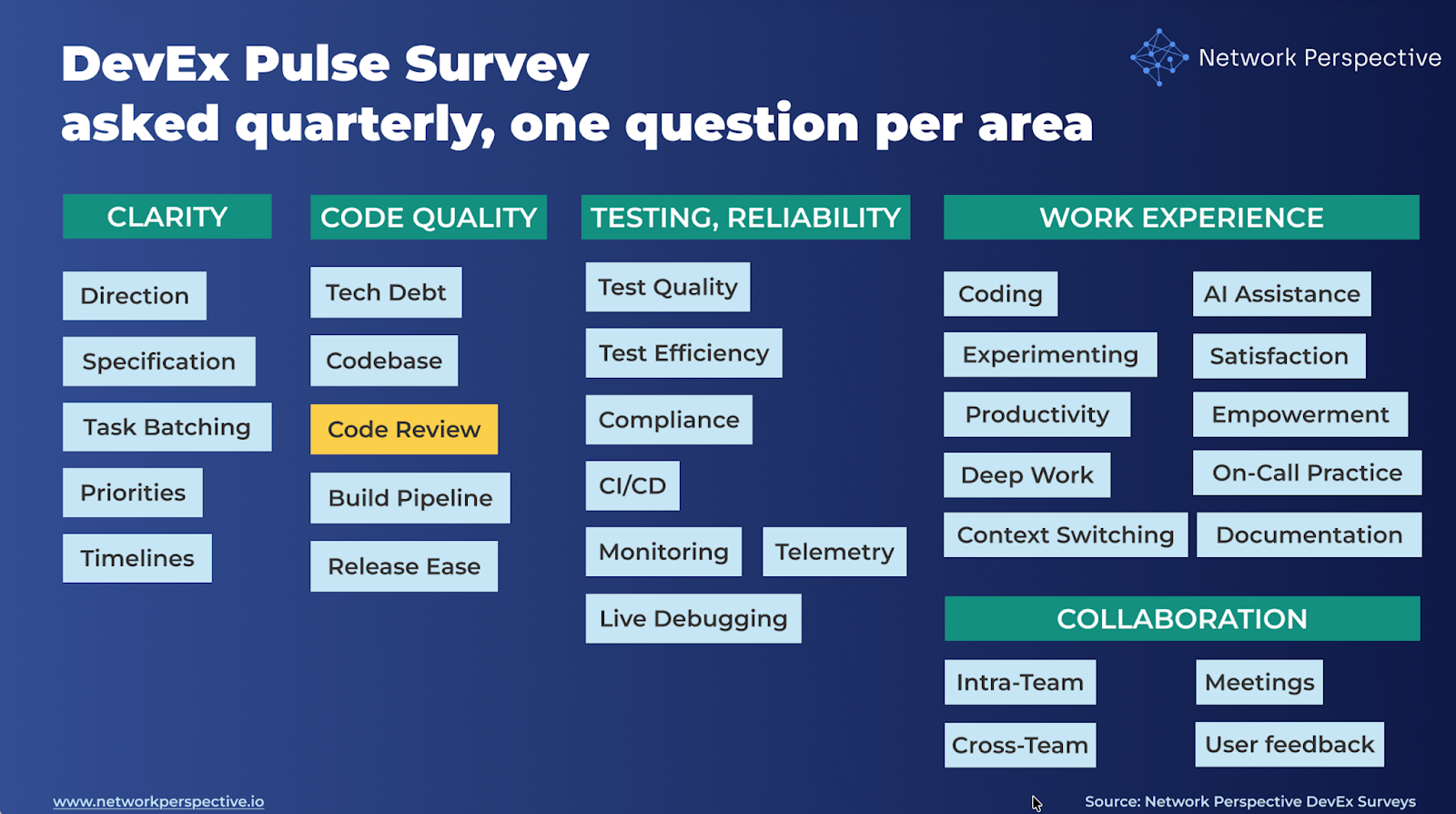
In our DevEx AI tool, we use two sets of survey questions: DevEx Pulse (one question per area to track overall delivery performance) and DevEx Deep Dive (a focused root-cause diagnostic when something needs attention).
DevEx Pulse tells us where friction is. DevEx Deep Dive tells us why it exists.
Let’s take a closer look at Code review. If the Pulse question “Code reviews are timely and provide valuable feedback” receives low scores and developers’ comments reveal significant friction and blockers, what should you do next?
Here are 15 deep dive questions you can ask your developers to uncover the causes of friction in code review, along with guidance on how to interpret the results, common patterns engineering teams encounter, and practical first steps for improvement. This will help you pinpoint what’s causing the problem and fix it on your own, or move faster with our DevEx AI tool and expert guidance.
Code Review — DevEx Survey Questions for Engineering Teams
The real question is: Do code reviews help changes move forward and improve quality — or do they mostly create waiting, rework, and stress?
Deep dive questions should help you map how code review flows through your delivery process and identify where it breaks down:
Responsiveness → Expectations → Feedback → Depth → Flow → Coverage → Safety → Cost
Here’s how the DevEx AI tool helps uncover this.
Speed
Do reviews happen fast enough?
- On time / Code reviews usually happen fast enough to keep work moving.
- Wait time / It’s usually clear how long a review will take.
What to check
Is it clear what reviewers look for?
- Checks / It’s clear what reviewers are expected to check for.
- Ready / Code is usually ready for review when it’s opened.
Feedback
Does feedback actually help?
- Useful / Review comments usually help improve the code or solution.
- Important / Feedback focuses on important issues, not small personal preferences.
Depth
Are the right things reviewed?
- Bugs / Reviews usually catch bugs or logic problems.
- Approach / Reviews look at whether the approach makes sense, not just formatting
Flow
Do reviews keep work moving?
- Few rounds / Reviews usually don’t go through many back-and-forth cycles.
- Next step / It’s clear what needs to be done after a review.
Coverage
Are reviews shared across the team?
- Team work / Reviewing code is treated as part of normal team work.
- No bottleneck / Reviews don’t depend on one specific person being available.
Tone
Do reviews feel safe and respectful?
- Respectful / Review comments are respectful and constructive.
- Safe / It feels safe to ask questions or push back in reviews.
Effort
- Weekly / Thinking about waiting for reviews, responding to review comments, and updating code after feedback, about how much time is spent in a typical week dealing with this?
- None
- Less than 1 hour
- 1–2 hours
- 3–5 hours
- 6–10 hours
- More than 10 hours
Open-ended question (for comments)
Ideas to spot or reduce friction?
How to Analyze DevEx Survey Results on Code Review?
Do code reviews help changes move forward and improve quality — or do they mostly create waiting, rework, and stress? Here’s how the DevEx AI tool helps make sense of the results.
How to Read Each Section
Speed
Questions
- On time – Code reviews usually happen fast enough to keep work moving
- Wait time – It’s usually clear how long a review will take
What this section tests
Whether reviews are fast and predictable, or a source of waiting and uncertainty.
How to read scores
- On time ↓, Wait time ↓
→ Reviews regularly block progress. - On time ↑, Wait time ↓
→ Reviews happen quickly sometimes, but timing is unpredictable. - On time ↓, Wait time ↑
→ Expectations are clear, but reviews still take too long.
Key insight
Slow or unpredictable reviews turn finished work back into waiting work.
Open-ended comments – how to read responses
- “Waiting days” → review backlog
- “Depends who’s around” → availability issue
- “Hard to plan around reviews” → unpredictability
Key insight
Waiting time is one of the biggest hidden costs in delivery.
What to check
Questions
- Checks – It’s clear what reviewers are expected to check for
- Ready – Code is usually ready for review when it’s opened
What this section tests
Whether there is a shared understanding of what a good review looks like.
How to read scores
- Checks ↓, Ready ↓
→ Reviews start before work is actually ready. - Checks ↑, Ready ↓
→ Standards exist, but work is rushed into review. - Checks ↓, Ready ↑
→ Code is ready, but reviewers don’t agree on what to look for.
Key insight
Unclear review expectations cause rework and frustration.
Open-ended comments – how to read responses
- “Different reviewers want different things” → unclear checks
- “PR opened too early” → readiness issue
- “Surprise comments late” → missing shared bar
Key insight
Reviews work best when everyone knows the bar before review starts.
Feedback
Questions
- Useful – Review comments usually help improve the code or solution
- Important – Feedback focuses on important issues, not small preferences
What this section tests
Whether reviews add value, not noise.
How to read scores
- Useful ↓, Important ↓
→ Reviews feel picky or pointless. - Useful ↑, Important ↓
→ Feedback helps, but time is spent on small details. - Useful ↓, Important ↑
→ Big issues are mentioned, but comments aren’t actionable.
Key insight
Good reviews improve the work, not just comment on it.
Open-ended comments – how to read responses
- “Lots of nitpicks” → low signal feedback
- “Doesn’t really help” → low usefulness
- “Same comments every time” → unclear standards
Key insight
Too much low-value feedback slows work and hurts morale.
Depth
Questions
- Bugs – Reviews usually catch bugs or logic problems
- Approach – Reviews look at whether the approach makes sense, not just formatting
What this section tests
Whether reviews focus on the right level of problems.
How to read scores
- Bugs ↓, Approach ↓
→ Reviews miss important issues. - Bugs ↑, Approach ↓
→ Reviews focus on correctness, not design. - Bugs ↓, Approach ↑
→ High-level discussion, but bugs slip through.
Key insight
Reviews should catch real problems early, not just polish code.
Open-ended comments – how to read responses
- “Bugs found later” → shallow review
- “Design issues caught too late” → missing depth
- “Mostly style comments” → wrong focus
Key insight
Shallow reviews push problems downstream.
Flow
Questions
- Few rounds – Reviews usually don’t go through many back-and-forth cycles
- Next step – It’s clear what needs to be done after a review
What this section tests
Whether reviews move work forward smoothly.
How to read scores
- Few rounds ↓, Next step ↓
→ Reviews feel chaotic and drawn out. - Few rounds ↑, Next step ↓
→ Work moves, but instructions aren’t clear. - Few rounds ↓, Next step ↑
→ Feedback is clear, but too much back-and-forth is needed.
Key insight
Clear next steps matter as much as fast feedback.
Open-ended comments – how to read responses
- “Lots of back-and-forth” → unclear expectations
- “Not sure when it’s done” → unclear next step
- “Keeps bouncing” → flow break
Key insight
Review churn is a sign of unclear standards or timing.
Coverage
Questions
- Team work – Reviewing code is treated as part of normal team work
- No bottleneck – Reviews don’t depend on one specific person
What this section tests
Whether reviewing is shared and reliable, not fragile.
How to read scores
- Team work ↓, No bottleneck ↓
→ Reviews depend on heroics. - Team work ↑, No bottleneck ↓
→ Reviews matter, but capacity is limited. - Team work ↓, No bottleneck ↑
→ Reviews happen, but responsibility is unclear.
Key insight
Reviews that depend on a few people will always slow down.
Open-ended comments – how to read responses
- “Waiting on one person” → bottleneck
- “Reviewing is optional” → low priority
- “Nobody feels responsible” → ownership gap
Key insight
Review capacity is a system design choice.
Tone
Questions
- Respectful – Review comments are respectful and constructive
- Safe – It feels safe to ask questions or push back in reviews
What this section tests
Whether reviews are psychologically safe, not stressful.
How to read scores
- Respectful ↓, Safe ↓
→ Reviews create tension or fear. - Respectful ↑, Safe ↓
→ Tone is polite, but disagreement feels risky. - Respectful ↓, Safe ↑
→ Open discussion exists, but comments may feel harsh.
Key insight
Unsafe reviews reduce learning and slow improvement.
Open-ended comments – how to read responses
- “Afraid to comment” → low safety
- “Feels personal” → tone issue
- “Hard to disagree” → power dynamics
Key insight
Safety determines whether reviews improve code or just approve it.
Effort
Question
Weekly – Time spent waiting for reviews, responding to comments, and updating code after feedback
- 0–1 hr/week → Healthy review flow
- 1–3 hrs/week → Some friction
- 3–5 hrs/week → Systemic drag
- 6+ hrs/week → Must-fix review problem
Key insight
Time spent in review is the clearest signal of review health.
Pattern Reading (Across Sections)
Pattern — “Slow Gate”(Common)
Pattern:
Speed ↓ + Effort ↑
Interpretation
Reviews act as a bottleneck.
Pattern — “Picky Reviews” (Common)
Pattern:
Feedback ↓ + Depth ↓
Interpretation
Time is spent on small things instead of real issues.
Pattern — “Unclear Bar” (Very common)
Pattern:
What to check ↓ + Flow ↓
Interpretation
Teams don’t agree on what “good” looks like.
Pattern — “Single Reviewer Risk” (Medium)
Pattern:
Coverage ↓ + Speed ↓
Interpretation
Availability controls delivery.
How to Read Contradictions (This Is Where Insight Is)
Contradiction On time ↑, Effort ↑
Reviews are fast, but rework is high.
Contradiction Useful ↑, Few rounds ↓
Feedback helps, but standards aren’t shared.
Contradiction Team work ↑, No bottleneck ↓
Reviews matter, but capacity is under-sized.
Contradiction Respectful ↑, Safe ↓
Polite tone, but power imbalance remains.
Contradictions show where the system looks healthy but still hurts.
Final Guidance — How to Present Results
What NOT to say
- “People need to do better reviews”
- “Developers are too slow”
- “Reviewers are too picky”
What TO say (use this framing)
“This shows how our review system helps or hurts delivery.”
“The issue isn’t individuals — it’s review timing, clarity, and capacity.”
One Powerful Way to Present Results
Show three things only:
- How long reviews take
- Whether feedback helps or distracts
- How many hours per week reviews cost
Using DevEx Code Review Insights to Improve How Teams Deliver High-Quality Code Without Slowing Delivery
Here’s how the DevEx AI tool will guide you toward making first actions.
First Steps Per Section
Speed
Goal: Reduce waiting and make review timing predictable.
First steps
- Introduce a review response expectation (e.g., first response within 24h or same working day).
- Add a lightweight review queue (Slack/Jira/GitHub label like needs-review).
- Encourage small PRs to reduce reviewer effort.
- Add review rotation so responsibility is shared and visible.
What to Check
Goal: Align expectations before review starts.
First steps
- Create a simple “What to check in reviews” checklist (bugs, logic, security, tests, architecture fit).
- Add a PR template with readiness items: tests included, description of change, risks
- Encourage teams to self-check before opening PRs.
Feedback
Goal: Increase signal, reduce noise.
First steps
- Introduce a review guideline: focus on correctness, design, maintainability.
- Use style automation (linters, formatters) to remove style debates.
- Encourage reviewers to group feedback instead of many small comments.
Depth
Goal: Ensure reviews catch meaningful issues early.
First steps
- Encourage reviewers to ask “Does the approach make sense?” before commenting on details.
- Add design context to PR descriptions.
- Encourage early design discussion before large PRs.
Flow
Goal: Reduce back-and-forth cycles.
First steps
- Encourage clear review summaries: “Approve”, “Needs changes”, “One question”
- Ask reviewers to list all issues in one pass rather than drip comments.
- Encourage small follow-up commits instead of full PR rewrites.
Coverage
Goal: Remove reviewer bottlenecks.
First steps
- Set a team expectation that everyone reviews.
- Introduce review rotation or pairing.
- Encourage cross-reviewing within the team rather than relying on a single expert.
Tone
Goal: Maintain psychological safety.
First steps
- Introduce simple review norms: critique code, not people; explain reasoning; suggest improvements.
- Encourage questions instead of directives.
- Model good review behavior from senior engineers.
Effort
Goal: Reduce weekly time lost in reviews.
First steps
- Track PR size and encourage smaller changes.
- Measure time-to-first-review.
- Identify large or frequently reworked PRs and review their causes.
First Steps for Patterns
Pattern: Slow Gate
Speed ↓ + Effort ↑
First steps
- Set response-time expectations.
- Create a review queue or label.
- Encourage smaller pull requests.
Pattern: Picky Reviews
Feedback ↓ + Depth ↓
First steps
- Automate style checks (formatter, linting).
- Define review focus areas (logic, correctness, architecture).
- Encourage reviewers to prioritize critical feedback first.
Pattern: Unclear Bar
What to check ↓ + Flow ↓
First steps
- Create a short review checklist.
- Add PR templates.
- Share examples of good review comments.
Pattern: Single Reviewer Risk
Coverage ↓ + Speed ↓
First steps
- Introduce review rotation.
- Encourage pair reviewing.
- Identify areas where knowledge is concentrated and spread it.
First Steps for Contradictions
Contradiction On time ↑ + Effort ↑
Reviews are fast, but rework is high.
First steps
- Improve PR readiness before opening.
- Encourage smaller PRs.
- Add clear review expectations.
Contradiction Useful ↑ + Few rounds ↓
Feedback helps but there is too much back-and-forth.
First steps
- Encourage reviewers to give complete feedback in one pass.
- Improve PR descriptions and context.
Contradiction Team work ↑ + No bottleneck ↓
Reviews matter but capacity is insufficient.
First steps
- Add review rotation.
- Encourage everyone to review regularly.
Contradiction Respectful ↑ + Safe ↓
Tone is polite but disagreement is uncomfortable.
First steps
- Encourage question-based feedback.
- Normalize discussing alternative approaches.
The Core Improvement Rule
Improve clarity and readiness before the review starts.
Most review friction comes from unclear expectations or unfinished work entering review.
When:
- the review bar is clear
- the PR is ready
- and PRs are small
reviews naturally become faster, deeper, and less stressful.
The Most Powerful First Step Overall
Introduce a simple PR readiness and review checklist. Example:
Before opening a PR
- Code compiles and tests pass
- Description explains the change
- Risks or edge cases noted
During review
- Check logic and correctness
- Check design and approach
- Avoid style comments unless necessary
This single step usually improves:
- review speed
- feedback quality
- flow
- review effort
at the same time.
There’s Much More to DevEx Than Metrics
What you’ve seen here is only a small part of what the DevEx AI platform can do to improve delivery speed, quality, and ease.
If your organization struggles with fragmented metrics, unclear signals across teams, or the frustrating feeling of seeing problems without knowing what to fix, DevEx AI may be exactly what you need. Many engineering organizations operate with disconnected dashboards, conflicting interpretations of performance, and weak feedback loops — which leads to effort spent in the wrong places while real bottlenecks remain untouched.
DevEx AI brings these scattered signals into one coherent view of delivery. It focuses on the inputs that shape performance — how teams work, where friction accumulates, and what slows or accelerates progress — and translates them into clear priorities for action. You gain comparable insights across teams and tech stacks, root-cause visibility grounded in real developer experience, and guidance on where improvement efforts will have the highest impact.
At its core, DevEx AI combines targeted developer surveys with behavioral data to expose hidden friction in the delivery process. AI transforms developers’ free-text comments — often a goldmine of operational truth — into structured insights: recurring problems, root causes, and concrete actions tailored to your environment.
The platform detects patterns across teams, benchmarks results internally and against comparable organizations, and provides context-aware recommendations rather than generic best practices.
Progress on these input factors is tracked over time, enabling teams to verify that changes in ways of working are actually taking hold, while leaders maintain visibility without micromanagement. Expert guidance supports interpretation, prioritization, and the translation of insights into measurable improvements.
To understand whether these changes truly improve delivery outcomes, DevEx AI also measures DORA metrics — Deployment Frequency, Lead Time for Changes, Change Failure Rate, and Mean Time to Recovery — derived directly from repository and delivery data. These output indicators show how software performs in production and whether improvements to developer experience translate into faster, safer releases.
By combining input metrics (how work happens) with output metrics (what results are achieved), the platform creates a closed feedback loop that connects actions to outcomes, helping organizations learn what actually drives better delivery and where further improvement is needed.
Returning to our topic — code review — you can explore proven practices grounded in hundreds of interviews our team has conducted with engineering leaders, or take a look on Code Review Metrics – The Miro Way

